

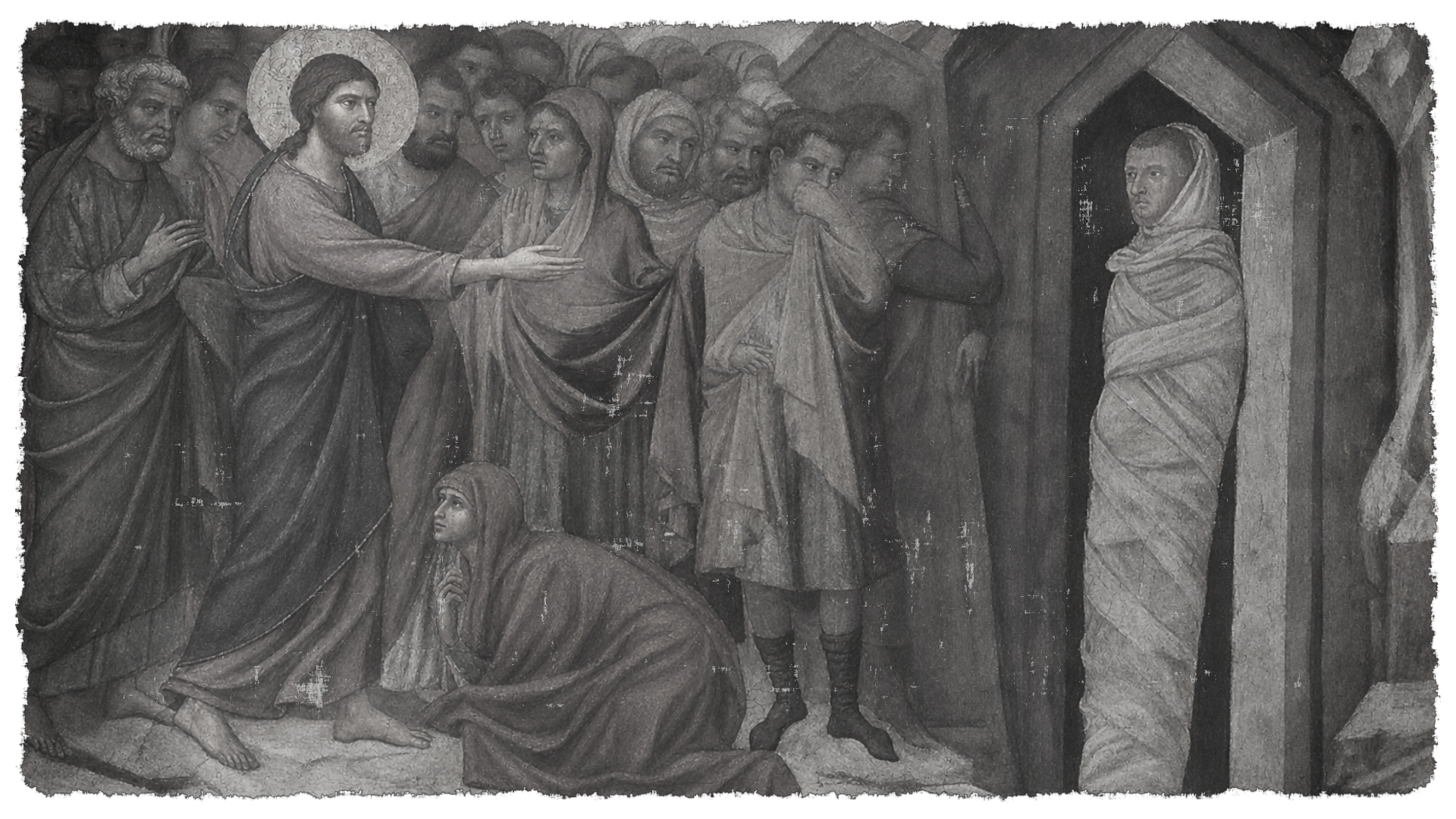
One of the shortest verses in Scripture is also among the most moving: “And Jesus wept” (John 11:35).
Christ stood before the tomb of His friend Lazarus, knowing that within moments He would call him forth from the dead. Yet He wept. His certainty that Lazarus would live again did not diminish His sorrow.
St. Paul expresses something similar when he urges Christians not to grieve “even as others who have no hope” (1 Thessalonians 4:13). He does not forbid grief. Death brings a genuine separation, even when we believe in the resurrection.
But what, exactly, does death separate?
Consider a Christian who dies in God’s grace. Has he ceased to belong to Christ? Certainly not. St. Paul declares that neither death nor life can separate us from the love of God in Christ Jesus (Romans 8:38–39).
The departed Christian remains united to Christ. On this much, Catholics and many Protestants readily agree.
The difficulty arises when we consider what that union means for the Church.
Can Death Divide Christ’s Body?
St. Paul describes the Church as Christ’s Body, whose members are united to Him and to one another (1 Corinthians 12:12–27). This is more than an association of people sharing religious beliefs. Through sanctifying grace, the faithful participate in God’s own life and belong to Christ as members of His Mystical Body. Their union with Him is inseparable from their membership in the one Body He has established.
Consider what follows.
If a Christian remains united to Christ after death, and Christ’s members form one Body, what happens to his communion with the other members?
His earthly life has ended. We can no longer speak with him across the dinner table, seek his advice, or enjoy his company. Those losses are painfully real.
Death also changes his condition far more radically than any earthly separation. The departed no longer participate in the Church’s earthly life as we do, and their continuing communion does not mean we can interact with them as though they were still among us.
Yet why should their supernatural union with the Church have ended?
The bond uniting Christians in Christ never depended upon their occupying the same place or sharing the same earthly condition. Its source is Christ Himself, who remains the Head of His Body whether its members are living upon earth or have departed this life.
If bodily death does not sever the faithful Christian’s union with Christ, why should it sever his communion with Christ’s other members?
Someone might accept that this communion endures while questioning whether it permits particular forms of spiritual assistance or intercession. That objection deserves examination in its own right. It does not, however, establish that death has dissolved the communion itself.
Here lies the distinction: A change in the manner of belonging is not necessarily a loss of belonging.
The Church has traditionally expressed this distinction by speaking of three conditions among her members.
The Church Militant consists of the faithful still struggling through earthly life. The Church Suffering comprises those who have died in God’s grace and are undergoing purification. The Church Triumphant consists of the blessed enjoying the vision of God.
These are different conditions within the one Church of Christ. The faithful on earth, the souls being purified, and the blessed in Heaven participate in the Church differently, yet remain united under the same Head.
This is the reality professed in the Creed as the Communion of Saints.
Death changes the condition of Christ’s faithful. It does not divide His Mystical Body into separate Churches.
A Mother’s Last Request
This understanding of the Church is no late theological invention.
In his Confessions (IX.11), St. Augustine recounts the final days of his mother, St. Monica. As death approached, she expressed little concern about where her body would be buried. She asked only that her sons remember her at the Lord's altar.
Consider what her request presupposes.
Monica knew that death would end her earthly life. She would no longer kneel beside her sons at Mass or join them in prayer as she had before. Yet she expected their prayers to remain meaningful for her after death.
Her request expresses the conviction that death would not place her beyond the communion of the Church. Her sons could still offer prayers for her within the worship of the same Church to which she continued to belong.
The ancient Christian practice of praying for the departed reflects this conviction, as does the Church’s veneration of the saints, which is distinct from the worship owed to God alone.
Continuing communion does not, by itself, settle every question about prayers for the dead or the intercession of the blessed. Those practices have their own theological foundations. Their underlying logic, however, becomes clearer once we recognize that death does not dissolve the Church’s supernatural unity.
The faithful departed have not become strangers to the Church.
The Hope That Remains
Return to Christ standing before Lazarus’s tomb.
Our Lord’s tears remind us that Christian hope does not abolish grief. Death deprives us of the earthly presence of those we love, and the promise of resurrection does not make that loss imaginary.
Yet the Communion of Saints reveals that the separation is real without being absolute or final.
Those who die in God’s grace remain united to Christ, and through Him to the faithful who continue their earthly pilgrimage. Their supernatural communion endures as they await the resurrection of the body, when death itself will finally be overcome.
We grieve because death has taken someone from our sight. We have hope because death has not taken that person from Christ’s Body.
Subscribe to The Distant Shore so you don’t miss the weekly essays.
Editor’s Note: This is the first in a four-part series exploring the Communion of Saints and the Church’s unity beyond the grave. The series examines our bond with the departed, prayers for the souls in Purgatory, the intercession of the saints, and the Church’s continuity across generations. At its heart lies a question: What does it mean to belong to a Church whose communion survives death?