
There is an ancient tendency to emphasize Christ’s divinity at the expense of his humanity. In its more extreme forms, it was called Docetism, the belief that Christ only seemed to suffer as a man rather than truly suffering as one.
Few believers might say anything so stark today. But the instinct can survive in subtler forms. “Yes, of course He was truly man,” we might say. But when the Gospels show Him weeping, afraid, or worn down with grief, we might imagine something else was really happening underneath: that the divine nature was steering the whole time, and the tears were more like a costume worn for our benefit than the expression of an actual human being’s interior life.
It can feel reverent, but it is, in fact, the opposite of what the Church has always insisted on, and it quietly empties the cross of much of what makes it good news.
What Was Not Assumed
There is an old axiom governing all of this, and it leaves no room for half measures: whatever was not assumed was not healed. If some part of your humanity, your fear, your grief, your capacity to be genuinely moved, was left out of what the Word took on when He became man, then that part of you is left outside the reach of the redemption.
The Church fought this out at real cost, refusing every attempt to make Christ’s humanity thinner or more passive than it actually was. What she insisted on instead is the plain sense of Hebrews: He was “tempted in all things like as we are, without sin” (Hebrews 4:15). Not tempted in appearance. Not moved in a manner of speaking. Tempted, grieved, and afraid as a man truly is.
Tempted, But Not Like Us
Here a careful distinction earns its keep, because “like as we are” (Hebrews 4:15) does not mean “exactly as we are” in every respect. Our temptations often rise from within, from a nature already disordered by the fall. We can, in that sense, even become the source of our own temptation. Saint James writes that “every man is tempted by his own concupiscence, being drawn away and allured” (James 1:14).
Concupiscence is the disordered inclination of our appetites toward things contrary to reason and the good. It is not itself sin, but one of the wounds left in human nature by the fall, giving temptation something within us to work upon.
Christ’s did not, and could not, work that way. He took on a human nature complete in every part, but not a fallen one. There was no old wound in Him for temptation to press on, no scar tissue pulling Him toward what He knew He shouldn’t want, the way there is in each of us.
In this respect, Christ’s temptation as the new Adam resembles Adam’s first temptation more than ours. Adam, before the fall, had no concupiscence either; temptation had to come to him from without. So too with Christ. His temptation was real, but it came entirely from without. He could be confronted with evil, tested by it, and made to suffer through it, without experiencing the disordered interior pull toward it that we know.
The desert’s stones, the kingdoms shown from the mountain, the mockery at Calvary: real trials, really faced, and refused every time, not because something in Him wanted to give in and didn’t, but because nothing in Him was bent toward giving in at all. That makes His victory no less real, only differently shaped, that is, the victory of a nature entirely whole facing a world entirely willing to break it.
His fear was real too, though without the disorder that so often accompanies fear in us. His human nature truly recoiled from suffering and death, while His human will remained perfectly subject to the Father. The distinction does not make His fear less real, but informs us what kind of fear it was.
Suffering That Isn’t Wasted
This is where the doctrine stops being merely correct and begins to change what we can do with our own suffering. Christ’s suffering was not simply alongside ours, a fellow sufferer keeping us company from a respectful distance. Since the one who suffered is a divine Person, His human suffering carries a weight ours cannot carry on its own, an infinite merit that our pain, left to itself, will never produce no matter how much of it we are asked to bear.
Saint Paul says something startling about this when he speaks of filling up “those things that are wanting of the sufferings of Christ” in his own flesh (Colossians 1:24). Not because Christ’s work was incomplete, but because He has joined us to Himself so completely that our suffering can be taken up into His and given a meaning it could never possess alone.
This is the whole of what the Church prays at the altar “through Him, with Him, and in Him.” Your suffering, offered that way, is no longer just suffering. It is joined to Christ’s own suffering, through which He accomplished our redemption.
This means the next hard thing asked of you, the diagnosis, the loss, the ordinary exhausting weight of an ordinary day, does not have to be endured alone and does not have to be wasted.
It can be offered.
Saint Peter calls us “living stones,” built into a spiritual house “to offer up spiritual sacrifices, acceptable to God by Jesus Christ” (1 Peter 2:5). Suffering, when offered through Him, can become such a sacrifice.
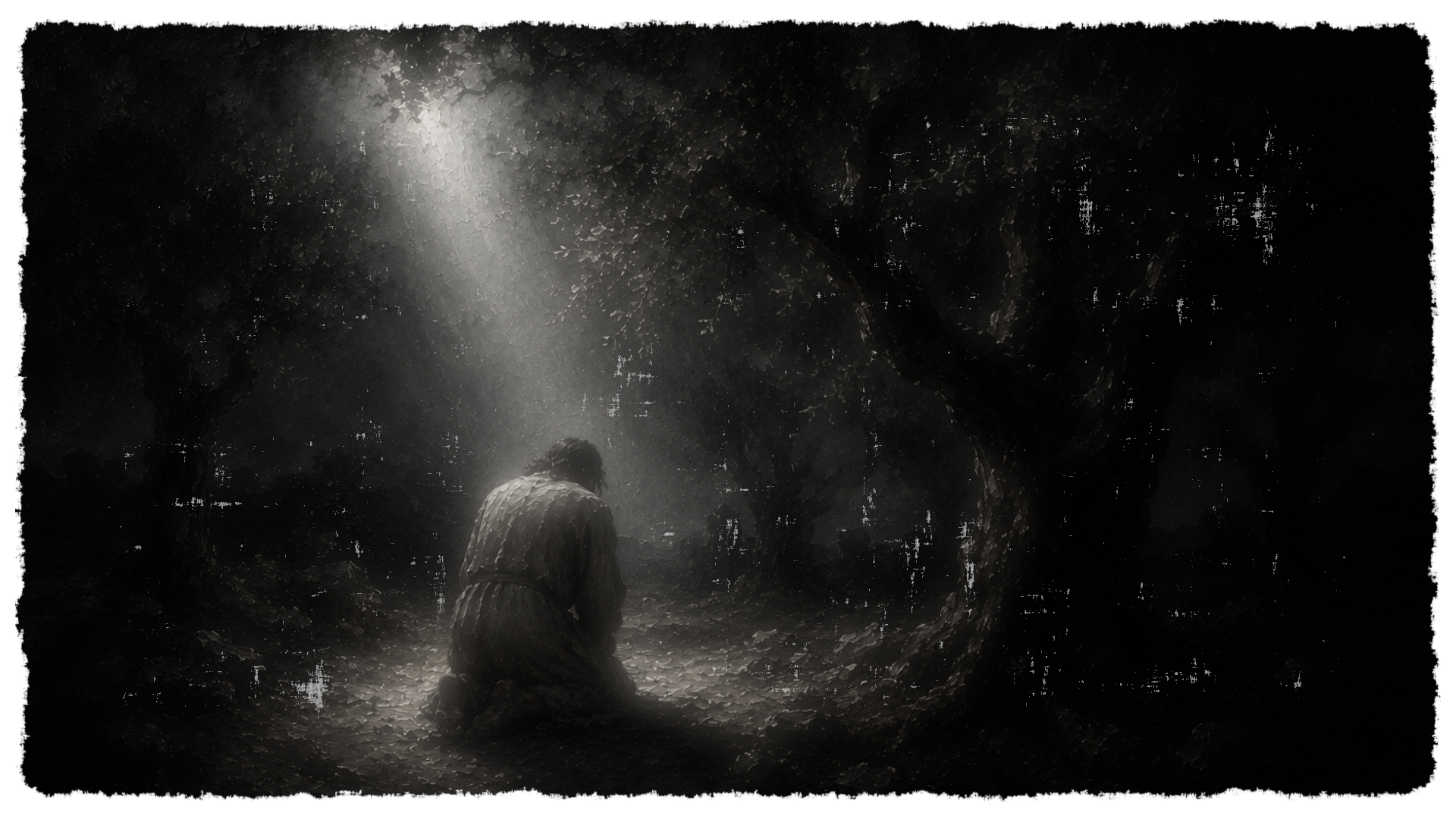
There is a garden where this was true first, and true most. Before any of it, before the nails, before the mockery, there was a man on His knees in the dark, sweating something like blood, asking if there were any other way, and then, because there wasn’t, going forward anyway.
That is not a story about a distant God arranging events from a safe remove. That is a man, truly a man, truly afraid, doing the one thing that made every fear you will ever carry worth carrying with Him instead of alone.
Subscribe to The Distant Shore so you don’t miss the weekly essays.
Editor’s Note: This is the third essay in a four-part series exploring what it means to be truly known by God. The series will address God’s perfect knowledge of us, the Incarnation, and certain ancient errors that often recur in new forms, all toward a deeper wonder and love of the God who knows us better than we know ourselves.