

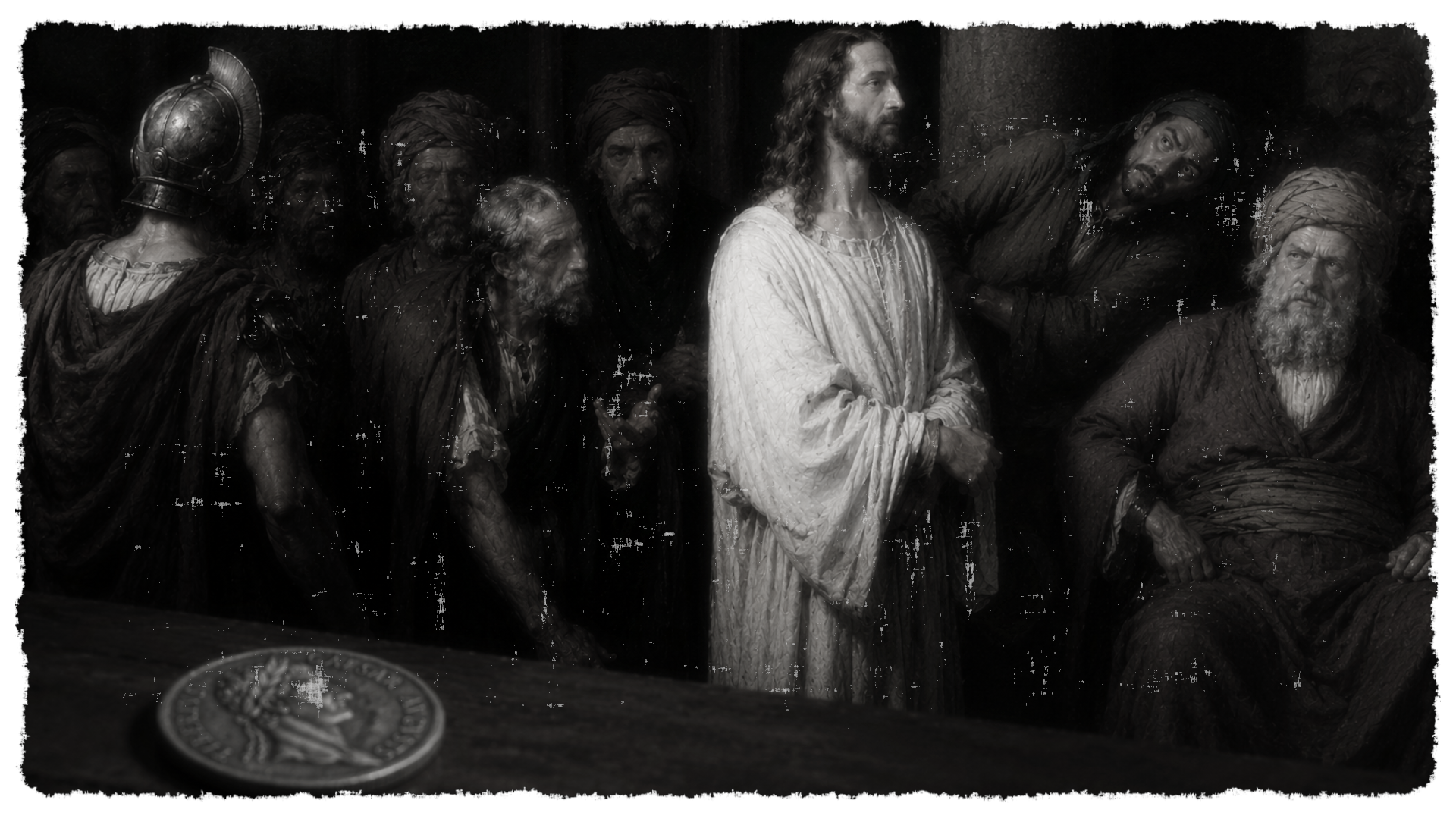
The Pharisees thought they had found the perfect trap.
If Christ rejected the Roman tax, He could be denounced as a rebel. If He endorsed it, He would appear to betray His own people. Instead, He asked for a denarius.
“Render therefore to Caesar the things that are Caesar’s, and to God the things that are God’s” (Matthew 22:21).
With a single distinction, the trap disappeared. Caesar received his coin; he did not receive the Kingdom.
The Church has spent two thousand years living alongside political powers without belonging to them. Kings have sought her blessing. Republics have sought her approval. Dictators have sought her silence. History has therefore presented the Church with many different relationships to political authority, but they are not all the same.
Who Is Judging Whom?
Standing before Pilate, Christ declared, “My kingdom is not of this world” (John 18:36). His kingdom had already entered history, yet it belonged to another order. The Church continues that same mission. She does not exist to construct political systems, but to prepare souls for the Kingdom of God.
Because the Church’s mission never changes, she remains the same in her essential nature even as history changes around her. From age to age and from nation to nation, she encounters different political circumstances. Those entrusted with governing her may respond with greater or lesser prudence, but the Church’s doctrine and mission remain unchanged. Her relationship to political authority therefore assumes different forms according to the circumstances in which she finds herself, while one question remains constant:
Who is judging whom?
Alliance: Civil Authority Accepts the Church’s Judgment
Sometimes civil rulers publicly acknowledge Christ’s kingship and willingly submit their authority to the Church’s moral judgment. In such circumstances the Church enjoys unusual freedom to preach the Gospel, administer the sacraments, and govern her own life. Pius XI regarded this as the proper ordering of the temporal to the supernatural because nations, no less than individuals, remain subject to Christ the King.
Subordination: Civil Authority Seeks to Judge the Church
Sometimes the relationship is reversed. Political authority attempts to dictate what the Church may teach, how she must govern, or even whether she may carry out her mission freely. This is not merely a different political arrangement. It is a corruption of the proper order itself, for the temporal claims authority over the supernatural. The state seeks to domesticate the Church by reducing the Bride of Christ to an instrument of political power.
The Byzantine Empire under emperors such as Justinian I provides the classic example of Caesaropapism, though history has witnessed many similar attempts, from the persecutions of the early Roman Empire to modern totalitarian regimes. Here the Church no longer forms Caesar’s conscience. Caesar attempts to form hers.
Toleration: The Ideal Is Not Available
History rarely presents ideal circumstances. The Church may therefore work within political arrangements that fall short of the Christian ideal without endorsing them as such. Leo XIII urged French Catholics to cooperate with the Third Republic, not because it represented the ideal political order, but because prudence sometimes requires preserving the common good under imperfect conditions while continuing the Church’s supernatural mission.
Condemnation: Political Authority Rejects the Moral Law
Some political systems cannot be tolerated because their governing principles contradict the moral law itself. Pius XI therefore called communism “intrinsically evil,” not merely because of its methods, but because it denied fundamental truths about God, man, and society, reducing the human person to material and political categories that no state has the authority to define.
In such cases, the Church does not negotiate her principles. She bears witness to the truth, whatever the cost.
The Church’s Freedom
The Church may bless what is good, tolerate what cannot presently be changed, and condemn what is evil because her authority comes from Christ rather than from the political order in which she lives. She does not receive her mission from Caesar, and she cannot surrender it to him.
The Church serves the world best when she remains free to judge it according to the Gospel rather than being judged by it.
Thus, the faithful should be cautious whenever the Church is expected to become the religious expression of any political movement. The Church serves every political order best precisely by belonging completely to none of them.
The kingdoms of this world rise and fall because they belong to the temporal order. The Church remains because she belongs to the supernatural one, awaiting the return of her Bridegroom.
Subscribe to The Distant Shore so you don’t miss the weekly essays.
Editor's Note: This essay is the second in a four-part series exploring the relationship between the supernatural and temporal orders. Each essay develops a distinct aspect of the argument before a concluding architectonic essay draws the threads together into a broader theological synthesis.