

“Who is my mother, and who are my brethren?”
It is a startling question, especially coming from Jesus. His mother was standing outside, wishing to speak with Him, and His response seemed almost dismissive. Stretching out His hand toward His disciples, He declared: “Whosoever shall do the will of my Father, that is in heaven, he is my brother, and sister, and mother” (Matthew 12:48–50).
Was Christ distancing Himself from Mary? Had His relationship with her become less important now that His public ministry had begun?
Before drawing that conclusion, we ought to examine the rest of Scripture, where Christ’s own words and actions tell a rather different story.
After Mary and Joseph found the twelve-year-old Jesus in the Temple, He returned with them to Nazareth, where, St. Luke tells us, “he was subject to them” (Luke 2:51).
Consider the extraordinary humility of that statement. The eternal Son of God, through whom all things were made, submitted Himself to the authority of His own creatures.
The Fourth Commandment, which requires us to honor our father and mother, comes from the Triune God. Yet in the Incarnation, He who is the Son of the Father from all eternity also became the Son of Mary. Would the divine Lawgiver fail to observe the very commandment He had given? Certainly not. Having assumed our humanity, Christ fulfilled that commandment perfectly, honoring His mother with all the love and obedience proper to a sinless Son.
Nor did Christ abandon that principle when His public ministry began.
When the Pharisees defended a practice that let someone ostensibly dedicate resources to God to avoid supporting his parents, Jesus condemned it. They were making void the commandment of God through their tradition (Mark 7:9–13).
Christ would not tolerate using religion as an excuse to neglect one’s parents. Are we then to believe that He casually disregarded His own mother?
There is a tendency to regard Mary as though her importance lay almost entirely in giving birth to Jesus, after which she receded into the background of His mission. But Scripture does not portray their relationship that way. Christ did not treat His mother as someone whose purpose had been fulfilled and whose significance had passed.
His words in Matthew 12 concern the proper order of our loves. Our relationship with God takes precedence over every earthly attachment, even the closest family bonds. But loving God above our parents does not mean loving our parents less than we ought.
We love them in God, never above Him.
And Mary herself was hardly excluded by the standard Christ established.
Long before Jesus asked who His mother was, the angel Gabriel had announced God’s will to her at Nazareth. Her answer was an act of willing obedience: “Behold the handmaid of the Lord; be it done to me according to thy word” (Luke 1:38).
Elizabeth recognized the significance of that response: “Blessed art thou that hast believed” (Luke 1:45).
Christ had declared that those who do His Father’s will belong to His spiritual family. Could anyone seriously suppose that Mary, whose obedience had welcomed the Incarnation itself, did not belong to that family?
Had Mary refused God’s will at the Annunciation, He would not have been standing there in the flesh to explain the importance of obeying it.
St. Augustine understood this distinction. He taught that Mary was more blessed in receiving Christ through faith than in conceiving Him in the flesh. Her greatness did not consist merely in having borne Him, but in having believed and obeyed.
She was His mother according to the flesh and His disciple according to faith. Christ honored both relationships.
The Woman and the New Eve
As we saw in our earlier discussion of the wedding at Cana, Mary brought a need before her Son, and He responded by performing His first miracle. But another detail is worth considering. Jesus addressed His mother as “Woman,” adding, “My hour is not yet come” (John 2:4).
Why call His own mother “Woman”?
The answer becomes more interesting in light of an ancient Christian understanding of Mary as the New Eve. St. Justin Martyr and St. Irenaeus taught that Mary’s obedience at the Annunciation answered Eve’s disobedience in the Garden of Eden. Eve listened to the serpent and participated in humanity’s fall. Mary listened to the angel and freely cooperated in the coming of its Redeemer.
Christ is the New Adam, who restores what the first Adam lost. Mary stands beside Him as the New Eve. Against this background, Jesus’ address to His mother can be understood as more than an ordinary form of address. It evokes the woman whose cooperation belongs to God’s work of redemption.
And John records Jesus addressing His mother as “Woman” again at another extraordinary moment.
At Calvary, the hour that had not yet come at Cana has finally arrived.
Behold Thy Mother
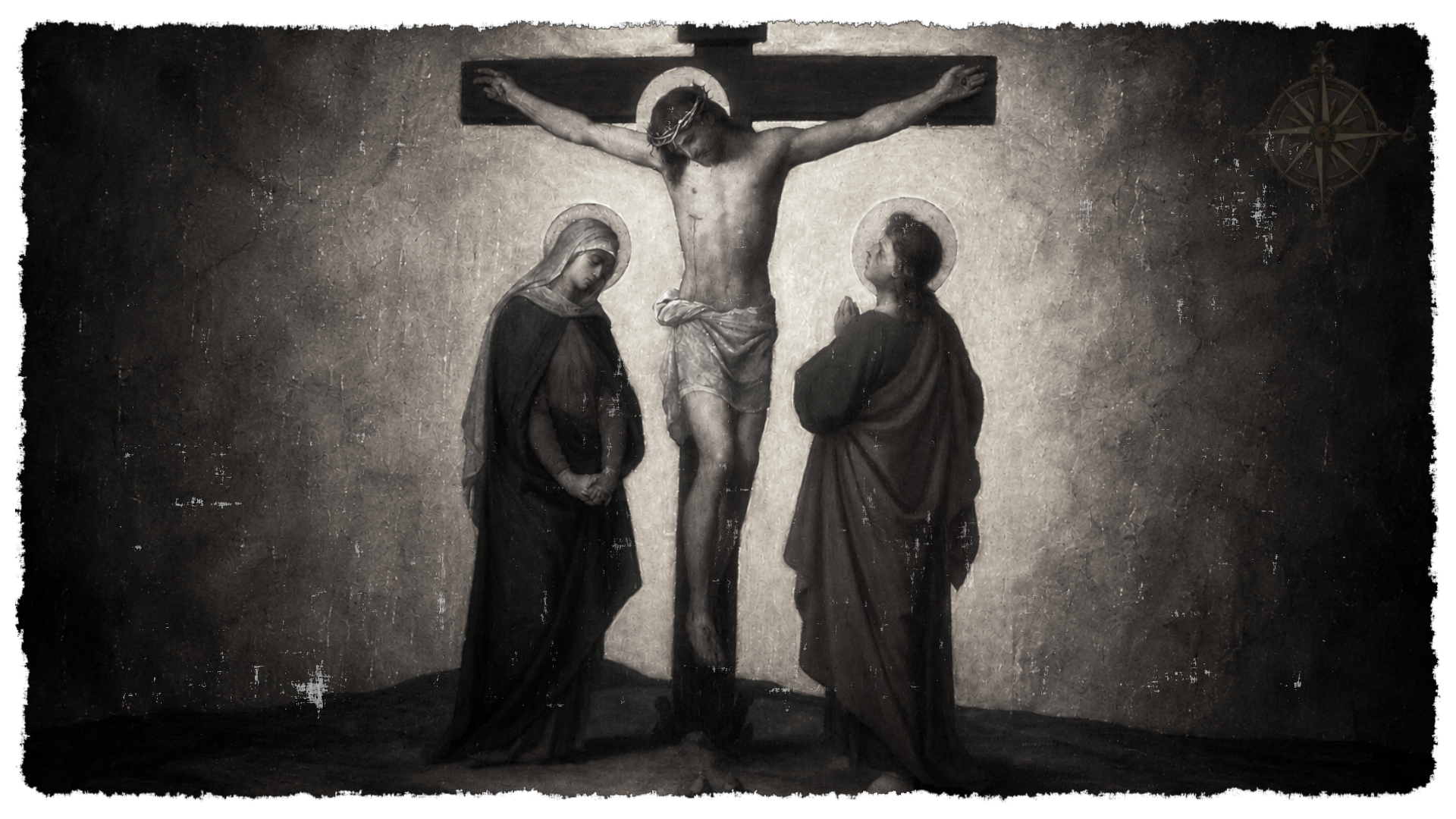
Jesus sees His mother standing near the Cross beside the disciple whom He loved. Addressing her again as “Woman,” He says, “Behold thy son.” Then He turns to the disciple: “Behold thy mother” (John 19:26–27).
Here, Christ fulfills the Fourth Commandment in the midst of His Passion. Even as He offers His life for the salvation of the world, He attends to His mother’s welfare.
But notice how He does it.
He does not simply instruct the disciple to provide for her. He gives Mary a son and gives the disciple a mother. Two people who are not related by blood are entrusted to one another in the language of family.
Now recall His earlier teaching. Who are His mother and brethren? Those who do the will of His Father.
At Calvary, Christ places His own mother, the woman who welcomed that will at the Annunciation, into a new maternal relationship with a disciple who has followed Him to the Cross.
The practical care is real. But the form of that care matters too. The Son who taught that obedience to God establishes a spiritual family now speaks of motherhood and sonship between two members of that family.
In Genesis, Eve is called the mother of all the living (Genesis 3:20). At Calvary, the New Adam, accomplishing our redemption upon the Cross, turns to the New Eve and gives her another son.
Consider what Christ has done. He has honored His mother according to the flesh while entrusting her to a son according to the spirit. The same Lord who taught that obedience to the Father establishes a spiritual family has now expressed His care for Mary through precisely such a relationship.
The notion that Christ regarded Mary with indifference, or that her significance ended with His birth, finds no support in His words or actions as recorded in the Gospels. Nor can His teaching about spiritual kinship in Matthew 12 be used to exclude the very woman whose faith and obedience were intimately tied to His Incarnation and whom He entrusted to His beloved disciple as one of His final acts upon the Cross.
His words were not a dismissal of His mother, but an affirmation of her unique place in the spiritual family He came to establish.
If Christ Himself loved and honored Mary in this way, what reason could His disciples have for treating her with indifference?
“Behold thy mother.”
Subscribe to The Distant Shore so you don’t miss the weekly essays.
Editor’s Note: This is the fourth and final essay in a series exploring the significance of Mary’s unique place in the Incarnation. Having considered her divine maternity, the Virgin Birth, and her intercession, we conclude by examining her continuing place in the life of the Church. Throughout the series, we have followed a simple truth: God chose Mary, and that choice means something.