

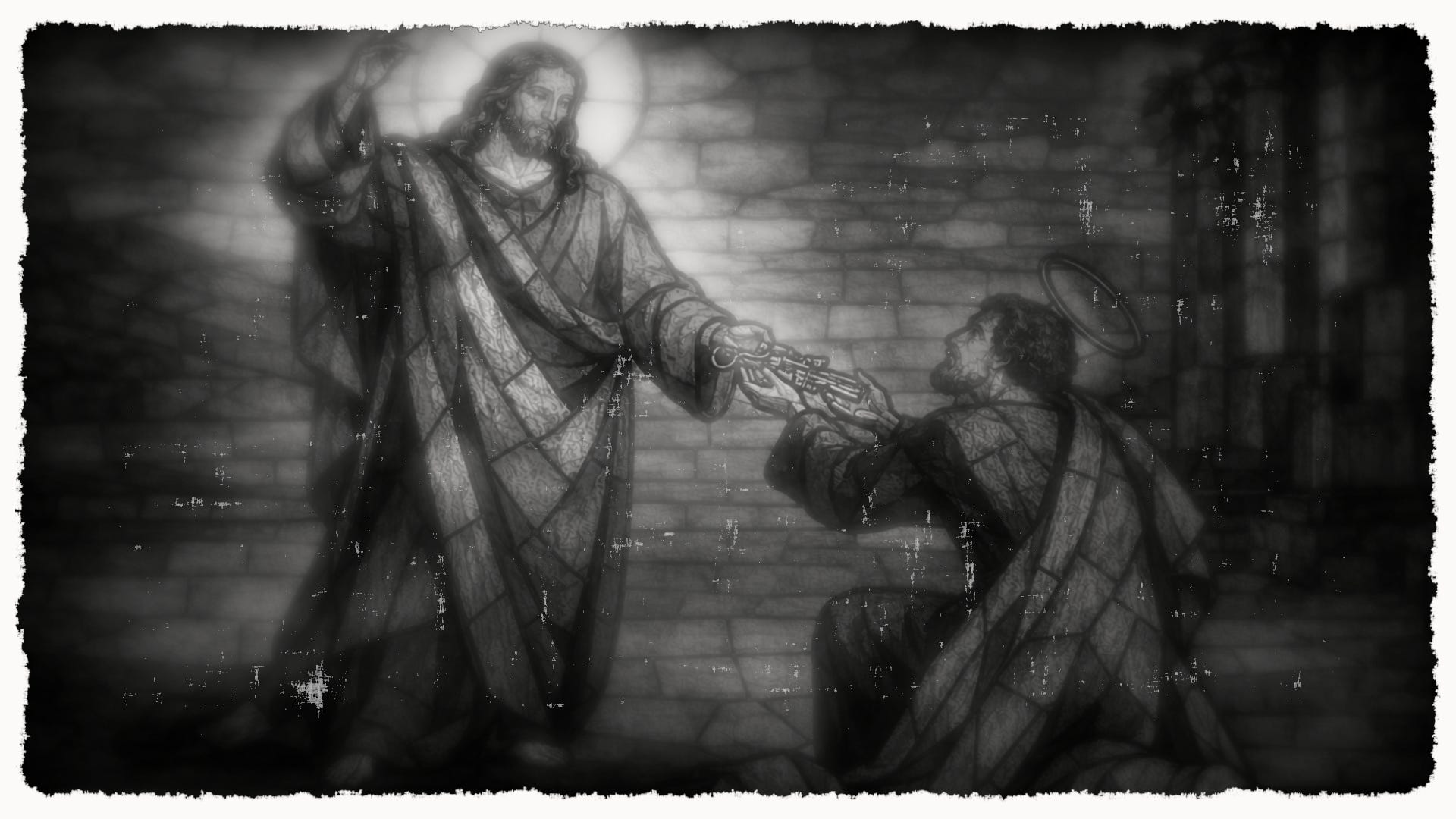
I recently came across a familiar objection, posed as though it were devastating: “Do you listen to the Church or to God?”
At first glance, the question feels almost impossible to answer cleanly. If you answer “God,” the Church appears secondary. If you answer “the Church,” you appear to place an institution above God Himself.
A False Dilemma
The apparent force of the question comes entirely from a hidden premise smuggled into it.
The contraband is a category mistake that misidentifies the nature of the Church’s authority by treating it as self-originated, as though the Church invented her own jurisdiction and now stands beside God, issuing rival commands. On this reading, the Church and Heaven are two offices filing conflicting memos, and the faithful must choose which desk to trust. But this is not a theological position; it’s a caricature of one.
The Church does not claim authority on her own behalf. She claims authority on Christ’s behalf by his explicit commission. “He that heareth you, heareth me; and he that despiseth you despiseth me” (Luke 10:16) is not an administrative courtesy. It is a jurisdictional statement. The authority of the Magisterium is derivative, that is, it flows from Christ, is guaranteed by the Holy Spirit, and is ordered entirely to transmitting what God has revealed.
Because that authority is derivative rather than self-originating, it is necessarily bounded by the revelation it serves. The Church possesses no jurisdiction to contradict Christ, reverse divine law, or bind the faithful to error. Obedience is therefore not servility to personalities, but submission to an office constituted to preserve and transmit a deposit it did not invent. The limitation is not a constraint imposed from outside on authority, but rather what distinguishes legitimate authority from usurpation in the first place.
Private Judgment in Disguise
To pit the Church against God, then, does not elevate God. Such pitting replaces the Church’s teaching authority with one’s own private judgment while calling the substitution an act of piety. The manualist tradition was characteristically blunt on this point: the man who rejects the Church’s authority in favor of his personal reading of Scripture has not found a more direct route to God. He has substituted private judgment for the Church’s teaching authority, or, in more colloquial speech, he has made himself pope.
This is not a novel error. This is Luther’s principle, stated at Worms in 1521 and repeated with remarkable fidelity on social media five hundred years later. His conscience was captive to the Word of God, he said, and neither popes nor councils could bind it without satisfying his own judgment. The subsequent five centuries thus produced some forty thousand denominations, each convinced it was listening to God rather than to men. That is not a sociological curiosity but a theorem proving itself.
If asked whether you listen to the Church or to God, a clever answer need not be given. Recognize that the question itself is the error, and that the only honest response is to say so.
Subscribe to The Distant Shore so you don’t miss the weekly essays.