

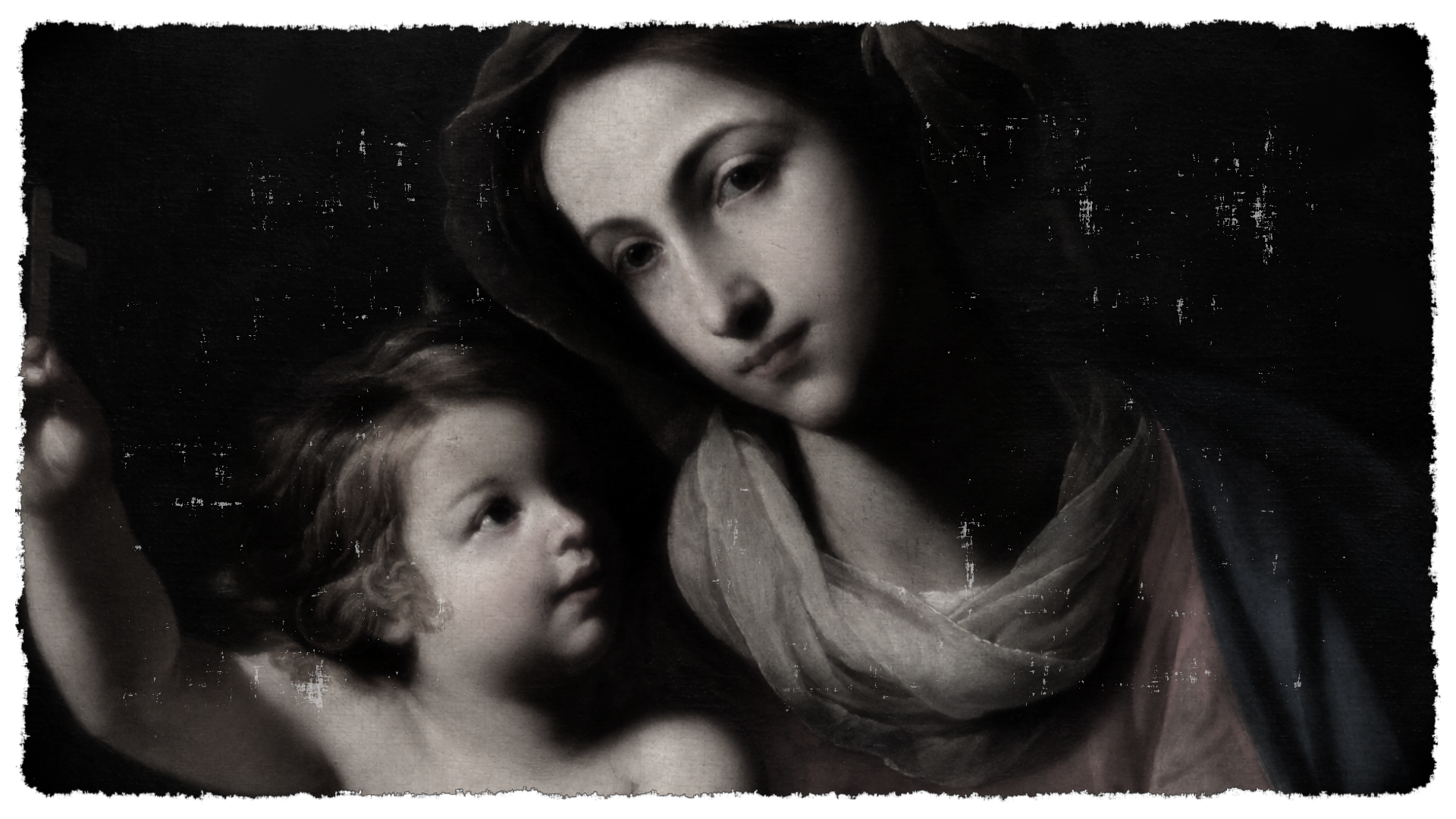
What does it mean to call Mary the “Mother of God”? Did Mary somehow give God His existence? Did she exist before Him? Did God, who is eternal, somehow have a beginning in her womb?
No. These are familiar misconceptions about Church teaching, and none of them reflects what the Church actually believes.
Mary is a creature like us, and like every one of us, she receives her existence from God. She could not give existence to the One from whom her own existence comes, nor could she precede the One who created her. The Son whom Mary conceived had existed eternally before Mary herself existed.
The difficulty in understanding the title “Mother of God” comes from something far more mysterious. The Incarnation is utterly singular. It has happened exactly once. God the Son entered His own creation and became man without ceasing to be God.
Nothing else in human experience is like it. Our ordinary categories, drawn from that experience, cannot adequately account for such a mystery. We must therefore make careful distinctions, allowing us to grow in our understanding of what God has revealed, even though we can never fully comprehend the mystery itself.
One of those distinctions is between a person and a nature.
A Human Being, but Not a Human Person
Nature answers the question: what is it? Person answers the question: who is it?
For us, the distinction is easy to overlook. I am a human being, and I am a human person. So are you. Every human being we have ever encountered is also a human person, so we naturally tend to treat the expressions as interchangeable. Yet a real distinction exists between them. Your nature is what makes you a human being. Your person is who you are, the individual who possesses that nature.
Christ is truly a human being. He has a real human body and a rational human soul, with a human intellect and a human will. Nothing necessary to complete human nature is missing from Him.
But Christ is not a human person.
Read that again. It is a true and mind-boggling statement. At first, it almost sounds as though we are denying Christ’s humanity. But recall the distinction we made earlier. Your human nature is what makes you a human being, while your person is the individual who possesses that nature.
The same distinction applies to Christ. His human nature is what makes Him a human being. But the Person who possesses that human nature is the eternal Son of God. Christ’s human nature does not belong to a newly created human person. It belongs to the divine Person of the Word, who exists eternally, without beginning or end.
The “who” in Jesus Christ is therefore God the Son Himself.
At every Sunday Mass, the identity of this Person is proclaimed in the Nicene Creed. He is “God from God, Light from Light, true God from true God, begotten, not made, consubstantial with the Father.” This is the Person who became man. The same Person who walked through Galilee, became hungry, slept, wept, suffered, and died exists eternally with the Father.
Now we can see why the Church calls Mary the Mother of God. A mother gives birth to a person, not merely a nature. My mother did not give birth to “human nature.” She gave birth to me.
So who did Mary give birth to? Jesus Christ. And who is Jesus Christ? God the Son.
Mary did not give Christ His divinity or cause the eternal Son to exist. Yet the Person she conceived and bore is that eternal Son. She is therefore rightly called the Mother of God, because the Person born of her is God, although He was born according to His human nature.
This is why the title matters. To deny Mary’s divine maternity on the grounds that she gave birth only to a human person is to introduce a division into Christ that does not exist, treating the man born of Mary and the eternal Son of God as two distinct persons. The Church condemned this error at the Council of Ephesus in 431, against Nestorius.
Christ is one divine Person, the eternal Word, who assumed a complete human nature into union with Himself. There are not two persons in Christ, one human and one divine. There is only one Person, the eternal Son of God.
Calling Mary the Mother of God is therefore a confession about Christ Himself. The title safeguards the unity of His Person.
A Mystery We Could Never Have Discovered
Christian theology developed precise language for these truths in part because Christians themselves struggled to understand them. We should therefore be sympathetic toward anyone who finds them difficult today. Ordinary human experience cannot provide an adequate comparison for a reality it could never have disclosed to us in the first place.
Human reason could not have discovered the Incarnation on its own. We can reason from creation to the existence of God and know certain things about Him by natural reason. But no philosopher, simply by thinking hard enough, could discover that God is Trinity or that the eternal Son would assume a human nature in the womb of a woman. Those truths had to be revealed.
St. Anselm captured the proper order beautifully: “I do not seek to understand in order that I may believe, but I believe in order that I may understand.”
Faith does not require us to stop thinking. A mystery can be genuinely understood without being fully comprehended. Revelation gives the mind truths it could never discover by its own powers, and faith allows us to begin understanding what has been given.
We can make the necessary distinctions, reject contradictions, and continually grow in our understanding. We can contemplate the mystery of the Incarnation for a lifetime without ever exhausting it.
There has been only one Incarnation, and therefore only one mother whose Son is a divine Person. There will never be another. Mary’s title is singular because the reality from which it follows is singular.
So what does it mean to call Mary the Mother of God? It means first that we have understood who her Son is. The title does not make Mary divine. It confesses that the child she bore is the eternal Son, true God and true man.
Christians readily call Jesus their brother, and rightly so. But consider what that means. We are not brothers of His human nature, as though a nature could be our brother. We are brothers of a Person, and that Person is the eternal Son of God. Through His assumption of our human nature, God the Son has truly become our brother. Indeed, Scripture tells us that He is not ashamed to call us His brethren (Hebrews 2:11).
Of course, no Christian imagines that calling Jesus his brother somehow makes the Christian divine. We understand perfectly well that the relationship exists through Christ’s humanity, while the Person to whom we are related is God Himself.
Now consider Mary. Scripture tells us plainly that she gave birth to Jesus (Matthew 1:25; Luke 2:7). It does not say that she gave birth merely to His human nature, or to some human person distinct from the eternal Son. She gave birth to Him. And that Person is the very One whom we call our brother: the eternal Son of God.
If we can truly call God our brother because He became man, why would we hesitate to call Mary the Mother of God?
Subscribe to The Distant Shore so you don’t miss the weekly essays.
Editor’s Note: This is the first essay in a four-part series exploring the significance of Mary’s unique place in the Incarnation. The series will consider her divine maternity, the Virgin Birth, her intercession, and her continuing place in the life of the Church, all beginning from a simple truth: God chose Mary, and that choice means something.