
This series has defended two truths that may seem unrelated. God’s knowledge of you is not caused by you but is the cause of you. And Christ’s humanity was not a costume worn over the divine nature, but a real and complete human nature, capable of fear, grief, and genuine temptation.
These are not separate corrections. Both refuse the same temptation: to make one truth easier to understand by diminishing another. And that refusal is the key to nearly every major controversy the Church has fought over who Christ is.
The Whole Truth, Held Whole
Scripture will not let you simplify the Incarnation in any direction. Saint Paul says that “in him dwelleth all the fulness of the Godhead bodily” (Colossians 2:9). Full stop, no partial indwelling, no divinity present in diminished form. Saint John says “the Word was made flesh” (John 1:14), and every word in that sentence is doing work.
The Word, fully God, was made, a real becoming, not an appearance, flesh, fully and completely human, not a convenient outer layer. Hold all of that together at once, without letting any piece of it slip, and you have orthodox Christology. Let any piece of it slip to relieve the tension of holding the rest, and you have a heresy, four of them, historically, each one a different way of putting the burden down.
The Council of Chalcedon eventually gave the Church four words to guard the whole thing at once: Christ is known in two natures, without confusion, without change, without division, without separation. Four heresies, moving in four different directions, each broke one of those guardrails. Together, they form a single family of errors: four different ways of solving the mystery by sacrificing part of it.
Too Little Humanity
The first temptation is to protect Christ’s divine dignity by shrinking His humanity. This is Apollinaris, condemned in 381, who taught that the divine Word simply took the place of a human rational soul in Christ, rather than Christ possessing a complete human mind and will of His own.
It is an understandable instinct to keep the divine in full control, not complicating the picture with a fully operative human interior. A Christ without a genuine human interior cannot actually live, weep, fear, or be tempted as a man, and what He never lived as a man, He has no power to heal in you.
Too Little Unity
The second temptation runs in the opposite direction, and this series has not yet named it. Nestorius, condemned at Ephesus in 431, did not deny Christ’s full humanity or His full divinity. If anything, he insisted on both so strongly that he could no longer say Christ’s humanity and divinity belonged to one and the same subject.
In his scheme, the man Jesus and the divine Word were conjoined so closely that they acted together, but the unity stopped short of one Person. In effect, a human someone remained alongside a divine someone.
This is why Nestorius balked at calling Mary the Mother of God. It was not because he doubted her greatness, but because, in his account, she was mother only to the human someone, not to the eternal Word.
Ephesus said no. Two persons are not cooperating in Christ. There is one Person, the eternal Word, who is genuinely the subject of a human birth, a human death, and a human mother. You may, and must, say Mary is the Mother of God, not because she causes the divine nature to exist, but because the child she bore is God.
Too Little Distinction
The third temptation is the mirror image of the second, and it belongs to Eutyches, condemned at Chalcedon in 451. Where Nestorius separated the natures so far that unity of person became unclear, Eutyches went the other way, insisting on unity so strongly that Christ’s human nature was, in his account, absorbed into the divine, blended into something new, neither fully human nor simply divine but a kind of third thing.
It sounds like it might be reverent, but it is actually the quiet erasure of the Incarnation’s whole point, because a humanity dissolved into divinity is no longer a real humanity at all, and a Christ with no real humanity left cannot be, in any meaningful sense, one of us.
Chalcedon’s answer became the Church’s permanent formula: two natures, unconfused, unchanged, each remaining fully what it is, united in one Person without division and without separation. Every word in that formula exists because someone tried to remove it.
Too Little Human Will
The fourth temptation is Eutyches’s error carried a step further, two centuries later. The Monothelites conceded, after Chalcedon, that Christ had two complete natures, but argued that He operated with a single will and a single mode of acting, since surely one Person could only will one way.
Constantinople III, in 680, said no again, for the same reason as before: a human nature with no distinct human will and no distinct human operation of its own is not a complete human nature at all, whatever you call it. Christ’s human will, genuinely His own and genuinely free, had to be real and capable of the anguish this series has already described in the garden. Otherwise, Gethsemane’s agony, “Not my will, but thine be done” (Luke 22:42), is not a man submitting his will to the Father, but theater with only one actor.
Why the Church Would Not Choose
Lay the four side by side and the pattern is exact.
Apollinarianism and Monothelitism relieve the tension by shrinking Christ’s humanity, His mind in the first case, His will in the second. Nestorianism and Eutychianism relieve it from the other side, one by pulling the natures too far apart, the other by blurring them together.
Every time, the Church had an easier option. She could have let the tension go slack in any of these four directions, and each alternative had serious defenders precisely because it seemed to protect something true: Christ’s divinity, Christ’s unity, Christ’s simplicity of action.
But she refused every one of them, at real cost, across two and a half centuries, because a Christ simplified in any of these ways is a Christ who can no longer reach and heal the actual, complicated human being standing in front of Him.
This is not just ancient history.
The same temptations remain available to anyone who finds the fullness of Christ too much to hold at once: the person who quietly treats Jesus as mostly a moral teacher with some divine flavoring added later, keeping the humanity but thinning out the divinity, or the believer so anxious to protect Christ’s majesty that His hunger and tears become details to be explained away rather than believed.
These temptations do not require Greek theological vocabulary. They require only impatience with mystery.
The Centurion Knew
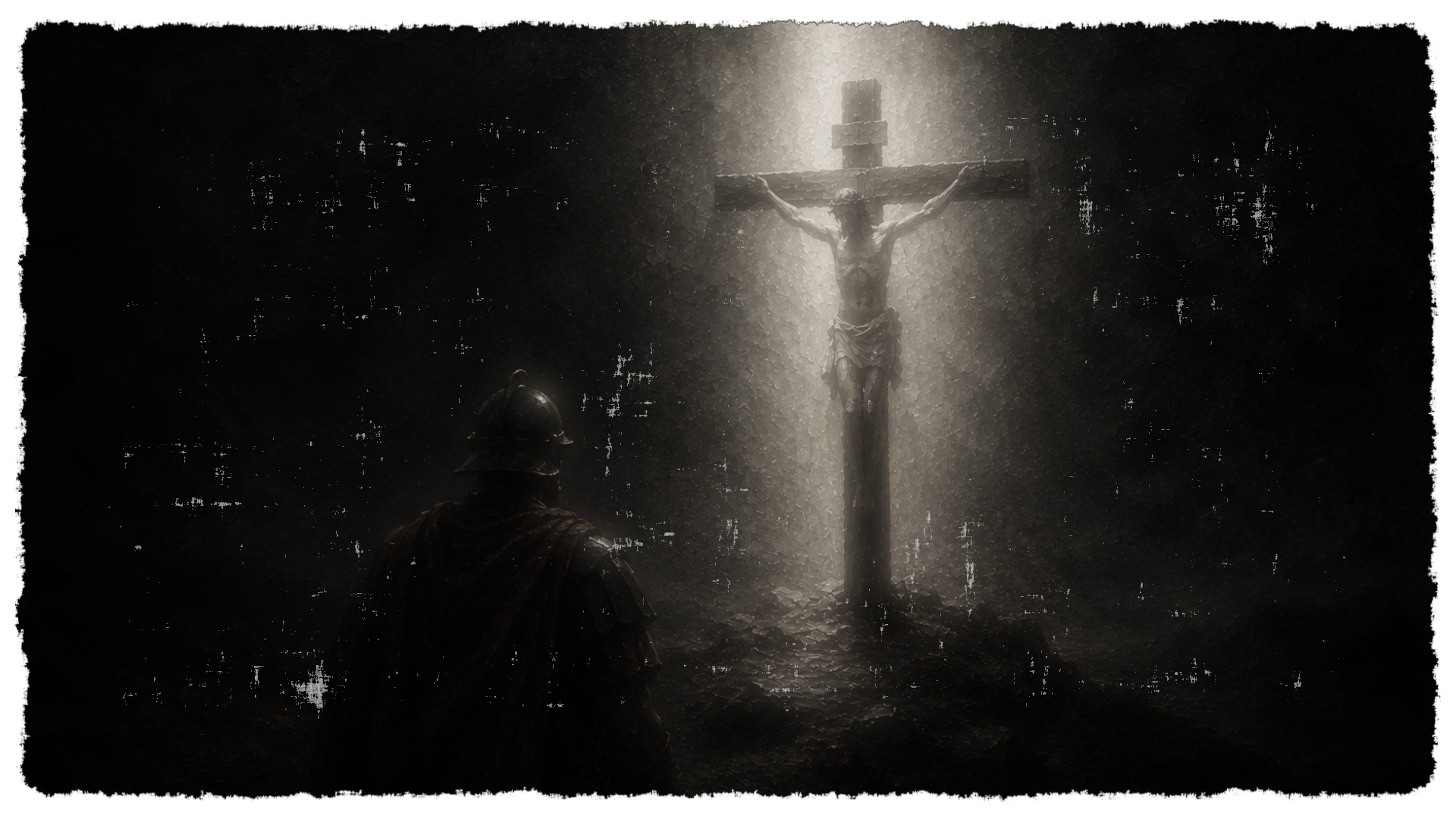
There is a moment, at the very end, where all four errors are answered at once, and not by an argument but by a man standing at the foot of a cross with no theology at all.
A Roman centurion watches Jesus die, genuinely and completely, the way any man dies, and says the only thing left to say: “Indeed this man was the son of God” (Mark 15:39). He does not need the word hypostatic. He simply sees, in a single moment, a man actually dying and God actually present, without either truth softening the other.
The Church would spend centuries finding the words for what the centurion saw.
It was there already in the garden, when Christ knelt in the dark and asked that the chalice pass from Him, then rose and went toward the cross anyway. The fear was human. The will that submitted was human. The Person who feared, willed, suffered, and died was the eternal Word.
That is why the Church would not give you a simpler Christ. A smaller one would have been easier to explain, but he could not have saved you. So she held the whole truth together: unconfused, unchanged, undivided, unseparated.
Nothing could be surrendered, because everything was at stake. The one who came to save you had to be truly God, truly man, and truly one. And perhaps that is the greater wonder behind all these centuries of argument: the God who knows you better than you know yourself loved you enough to become what He had made, so that what He had made could return to Him.
Subscribe to The Distant Shore so you don’t miss the weekly essays.
Editor’s Note: This is the final essay in a four-part series exploring what it means to be truly known by God. The series addresses God’s perfect knowledge of us, the Incarnation, and certain ancient errors that often recur in new forms, all toward a deeper wonder and love of the God who knows us better than we know ourselves.