
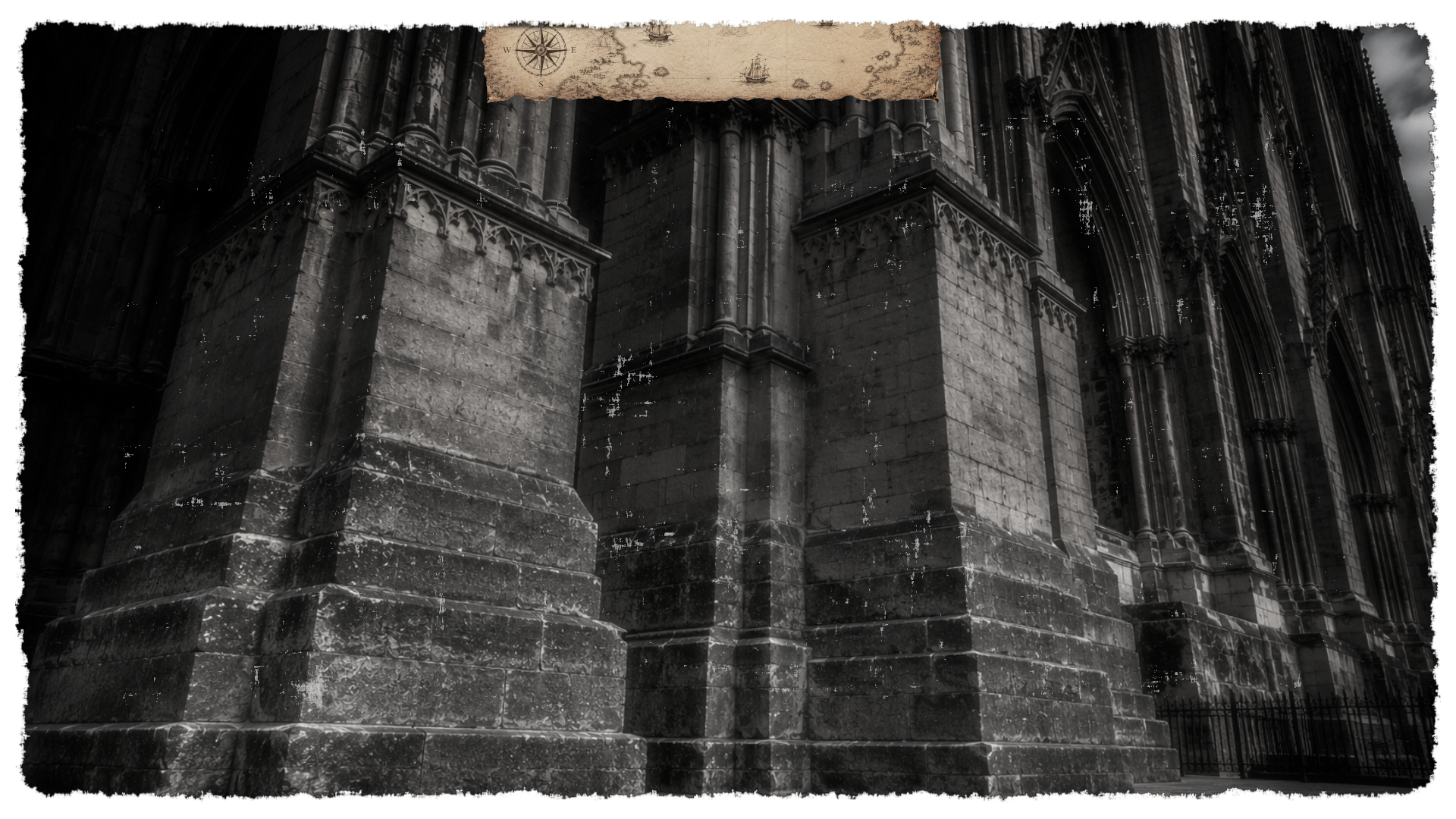
A cathedral needs a foundation. No pilgrim travels to Chartres to admire the foundation. No guidebook lingers on it, no postcard is sold of it, no one stands in the nave and looks down. Yet remove it, and the whole building collapses in an afternoon.
The foundation’s dignity is not that it competes with the nave or the spire for the pilgrim’s attention. Its dignity is that it holds up something greater than itself, and holds it up precisely by staying where it is, and by refusing to become anything else.
Politics is the foundation of the city of man. It is not the spire. This essay is an attempt to say, as plainly as the subject allows, what that means and what it does not mean.
The first essay in this series watched a crowd try to conscript Christ into their politics, after the multiplication of the loaves, wanting to make Him a king by force. He withdrew to the mountain, alone.
The second asked who judges whom, and found the Church free to bless, tolerate, or condemn Caesar precisely because her authority comes from God directly, not from Caesar.
The third refused the disciple two easy exits: he may neither flee the political order nor try to redeem it by ruling it outright. St. Louis governed for forty years without ever finding a formula that let him stop choosing rightly, decision by decision, case by case, a king with no shortcut around prudence.
That leaves the question this essay seeks to answer. If the disciple can neither abandon politics nor absorb it into his faith, what is politics actually for?
The Common Good Is Not the Final Good
Nothing in creation can be understood apart from the end for which it exists. We understand the eye by seeing, the family by the children it raises, the school by the education it imparts, and the cathedral by the worship it shelters. Political society is no different. If politics has a proper dignity, it must arise from the end toward which it is ordered.
Aquinas is direct about this in De Regimine Principum. Civil society exists to secure peace among its members, justice in their dealings, and the material and moral conditions in which men can live virtuously. It exists, in other words, to make a certain kind of life together possible. It does not exist to make men happy, not finally, and it certainly does not exist to save them.
The state can build roads, restrain the violent, adjudicate disputes, and defend its borders. It cannot absolve a single sin. It cannot beget a single act of charity in a single soul. No parliament, as parliament, has ever produced a saint.
This is not a complaint against the state. It is the state’s proper limit, stated with the same precision a mason uses when he says a foundation’s job is to bear weight, not to be seen. A foundation that resents its position and tries to rise into a spire does not make the cathedral taller. It makes the cathedral crumble.
Leo XIII saw the same principle from the far side of it, writing in Diuturnum Illud on the very nature of civil authority. Political power is real. It is willed by God, and Leo will not hear of anyone, monarchist or revolutionary, who tries to explain it away as a mere human contrivance with no author but the governed themselves.
But this same power, precisely because it is God’s before it is Caesar’s, is accountable to an order it did not write and cannot rewrite. A state that forgets this does not become more serious about its business. It becomes an idol with a bureaucracy, whether the idol wears the face of a throne, a party, a nation, or a procedure. The face changes. The disorder is always the same one: a foundation that has decided it is tired of being a foundation.
Two Ways to Forget the Limit
There are two ways to inhabit this disorder, and they look like opposites, which is exactly why each is tempting to the man who is only watching for the other one.
The first tries to correct the confusion of the age by making political power the direct guarantor of belief, the enforcer of orthodoxy by statute, mistaking the foundation for the altar it was only ever built to support.
It is, in its own way, a reverent error. It sees clearly that a state severed from truth cannot serve the common good, and then concludes, wrongly, that the state itself must therefore become the organ of truth’s enforcement.
It forgets that Christ, offered an earthly throne by an enthusiastic crowd, withdrew from it. The offer of temporal power in the service of the Kingdom is not a new temptation. It is the oldest one on record.
The second error empties politics of any shared end at all, reducing the common good to a neutral process, a set of procedures for adjudicating preferences that owes no account to what a human life is actually for. This error also sees something true: that political power, wielded badly, is dangerous, and that a state should not be trusted with the human soul.
It draws the wrong conclusion, that the state should therefore be trusted with nothing at all beyond bare procedure, as if a foundation could hold up a cathedral without agreeing to be shaped like one. A floor that need not bear any particular weight is not a modest foundation, but no foundation at all.
Both errors, moving from opposite directions, arrive at the same place: a politics that no longer knows it is subordinate. One tries to make politics carry the whole weight of man’s final end. The other refuses to let politics carry any weight of a final end whatsoever.
Both, not coincidentally, are answered by the same sentence, the one this series has been circling since its first essay: politics possesses its greatest dignity precisely because it is not man’s highest end.
Ordered, Not Abandoned
Notice what that sentence does not say. It does not say politics is unimportant. A foundation that fails still brings the cathedral down; a state that abandons justice, tolerates violence, or grows indifferent to the conditions of virtuous life is not thereby humble; it is simply failing at the one job assigned to it.
Subordination is not the same as insignificance. Christ’s refusal of an earthly throne on the mountain was not a statement that thrones do not matter. It was a statement about what a throne is for, and what it is not permitted to become.
This is the ground on which the disciple stands, then, neither withdrawn nor enthroned, doing the ordinary work St. Louis did across forty years of small decisions: litigating, building, reforming, defending what is just and opposing what is not, without ever confusing any of it for his final end, and without despising it as beneath his notice either.
The foundation is not the cathedral; it is also not nothing. Between those two errors, both real and both currently walking around in the world wearing respectable clothes, there is exactly one place to stand, and it is narrower than either error would like to admit.
The Foundation’s Work
Every regime built on the excited hopes of one election eventually crumbles into the disappointed hopes of the next, as the first essay observed. This is not cynicism about politics. It is only what follows from politics correctly located.
What does not crumble is the Kingdom the foundation was quietly built to carry, the one Christ withdrew from a mountain rather than accept prematurely, on the wrong terms, at the hands of a crowd that wanted the spire without ever having laid the foundation for it first.
The disciple’s task is not to tear down the foundation, and not to mistake it for the altar. It is to keep it level, keep it sound, and let it do, without complaint and without confusion, the one thing it was built to do: hold up the common good of persons whose final end is God, and hold it up precisely by staying where it is.
Subscribe to The Distant Shore so you don’t miss the weekly essays.
Editor's Note: This essay is the fourth and final installment in a four-part series exploring the relationship between the supernatural and temporal orders. Each essay develops a distinct aspect of the argument before this concluding architectonic essay draws the threads together into a broader theological synthesis.